Blog · 2026-09-16 Blog · 2026-09-16
The room on the eighth floor De kamer op de achtste verdieping
An illustrative case. The patterns come from our work, the people in it are fictional.
AI transformation works with the people you already have.
Research into AI transformation keeps arriving at the same split: about 10% of the success sits in the model, 20% in the data and the technology around it, and 70% in the human factor. Whether people want to use it. Whether it fits their work. Whether they are better off for it. This is the story of that 70%. Not as abstract change management, but as four periods from the life of a claims team. It could equally have been an accountancy firm, a recruitment agency, an installation business or a legal team. Wherever files, exceptions, client questions and handovers come together, the same pattern appears.
Walking along. Slowly.
Maria had already been with the claims team on the eighth floor for eleven years. She knew exactly what a damage file looked like, which policy conditions caused the pain, and which Friday-afternoon emails never got answered in time. She had a screen full of open tabs, three sheets of paper with her own shorthand, and a mentor who was retiring in two years.
When the PA arrived, her Personal Assistant in BlueHouse, she said: "No."
Not angry. Just no. She had no time to learn a tool, and she already had too many tools.
The PA did not impose itself. It walked along.
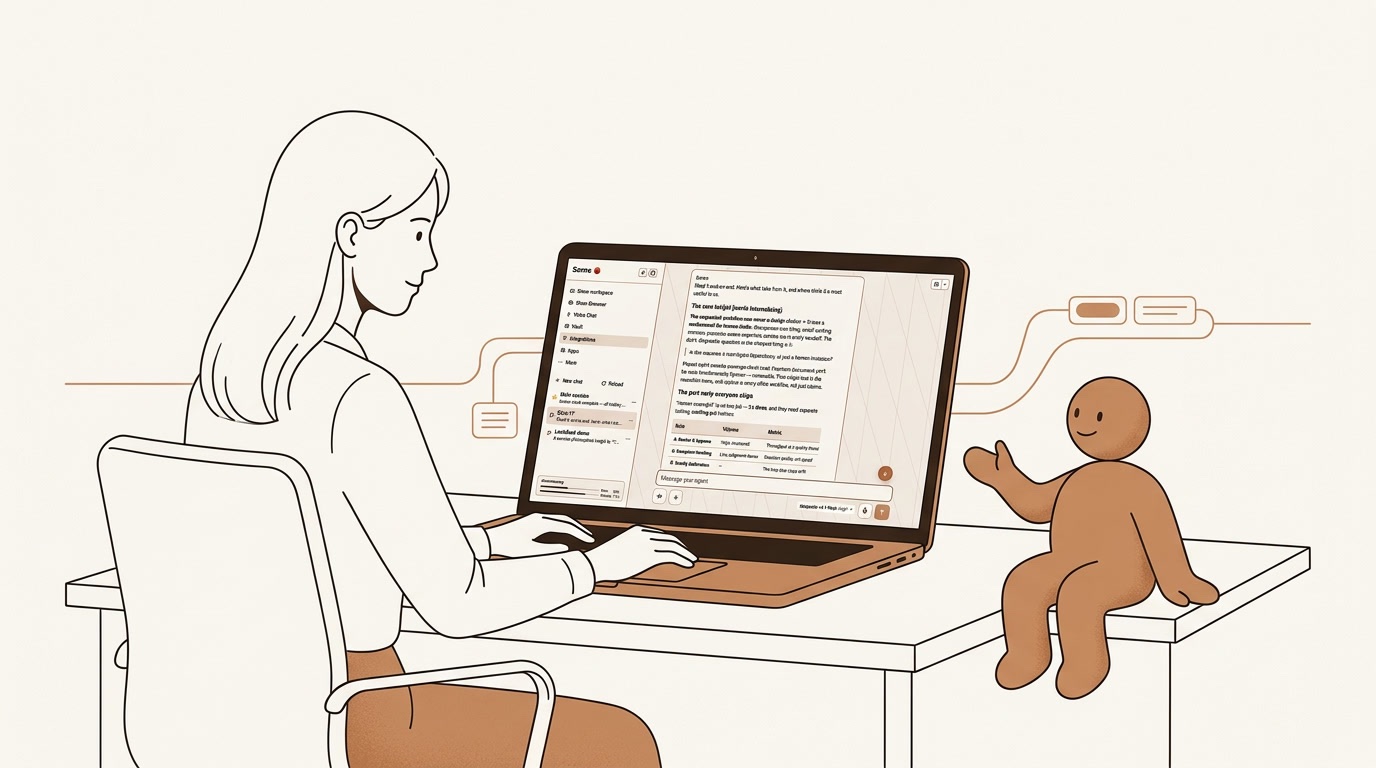
Not as an audit. As a shadow. It watched how Maria opened an incoming claim, read the fourteen documents one by one, retyped the same data three times into three systems, and then waited, for the lawyer, for the senior, for someone who was not gone on a Friday afternoon.
After two weeks the PA asked, at the moment Maria was rereading the same clause for the fourth time: "What are you actually checking for here?"
Maria answered in one line. Not because she had to, but because the question was right. It was exactly the right moment.
That evening they worked out something together that was bigger than the next claim: what Maria actually wanted to achieve in her work. Not separate little tasks, not "find that document" or "copy this over". But her outcome: a claim that is correct, handled quickly, and useful to the client. From then on the PA had that goal as its compass. Everything it did for her, it did from there.
That became the pattern. The PA learned from her moments. And Maria learned something back: not how the PA worked, but how she could steer on outcome instead of on steps. It came by itself, because the PA brought her back to it every time. She named the goal; it divided the goal into steps and came back with an answer that fit what she wanted to achieve.
She noticed it in small things. Instead of "find that document" she said: "I want to know whether this policy covers damage from water that came in through an open window." The PA did not come back with the document. It came back with the answer, plus the two clauses it had used, plus where it was unsure.
Maria sighed. "This is how I wanted to do it eleven years ago."
The PA remembered not only what Maria did, it remembered why it cost her energy. And that turned out to be gold, later.
The Room opens
The frustration had been there for months: claims took too long, files stalled at the handover to the legal department, and everyone checked in with everyone too often. Nobody had defined the problem properly.
Then the team lead, Jamal, opened a Workflow Board on the BlueHouse platform.
Not as another project site. As one place where the problem no longer sat in scattered emails, meetings and gut feelings, but became visible: what do we want to achieve, where does it get stuck, and when do we consider a solution good enough?
BlueHouse gave every employee their own PA. That PA first worked out the objective and the validation criteria one on one with the employee. Not just: which task has to be faster? But: which outcome has to become more reliable, more understandable or less draining?
The team fixed three simple agreements:
- a claim may not sit for more than five working days;
- nobody has to chase status any more;
- the legal handover has to be clear in one pass.
The rule: nothing is designed before these agreements are clear. Everyone may challenge them once, at the opening. After that they form the compass.
And then came the third. The AI and process consultant, not a project manager, not a PowerPoint generalist. She came with her own PA, like everyone. She did not come to draw the process and throw it over the fence. She came to be a human point of contact and to support the guidance, so that the team could learn how to redesign their own work. Her first question was: "Do you already know when this has succeeded?" Yes. Good. Then she did not need to ask it.
Now the real work began, and the workflow room became the workplace.
Priya asked what nobody said out loud: "Is this going to be used to measure who is slow?"
The consultant shook her head. "If that happens, this stops. The board is for workflow improvement, not for employee scoring."
That mattered. Only after that did people dare to put their real detours, doubts and workarounds on the table.
Sparring. Every employee had their own PA. It sparred one on one, warm, in the flow. Maria's PA asked at the moment of the fourth clause: "which three clauses is it actually always?" Jamal's PA asked on Friday at 16:45: "why is this question going to sit until Tuesday?" Priya's PA, who was sending forty "just checking" status-update emails a week, asked: "if this were one question instead of forty emails, what would that question have to be?"
Placing. What Maria discovered could go, with her permission, onto the shared board. With her name on it. Maria read along and corrected. Her concern got a name: "Maria's clause check." Nothing went to the team without the employee's agreement. That is how individual experience was integrated into team knowledge. It made the board an invitation, not surveillance.
Iterating. Now something happened that a normal project board does not do: the PAs helped combine patterns, while the team members kept reading along and correcting. Maria's PA put the clause check on the table. Jamal's PA connected another pattern to it: "that is exactly why my Friday answer does not come; the legal handover is only picked up when the coverage, points of doubt and proposed decision are complete in one pass. If one clause is missing, the file goes back to claims and misses the next review round." The consultant's PA put a question to the group: "if the handover were prepared automatically on the basis of the three clauses Maria already recognises, which exceptions would still need human judgement?"
In the open. Step by step. On the table, not in a corridor.
The team members read along. Responded. Changed their own contribution. The board did not become an archive, it became the place where personal knowledge became a new process together.
Towards a solution. That evening the PAs bundled the patterns the employees had approved. Not as a final recommendation, but as three possible designs that the team could assess the next morning. The disagreement was visible, not a masked compromise. The consultant looked, asked one question about who owned the exceptions, and let the team decide.
Testing on real work
No pilot with fake data. Ten real claims.
The new workflow ran: intake, extraction, external data sources and the fraud check went in parallel, not one after another. The handler did not look at every document, but at a screen showing: what has been extracted, with what confidence, where there was doubt. Fine? Confirm and move on. Doubt? Process further.
Maria's role changed. She was no longer the reader; she was the exception handler. The cases where the policy conditions did not fit cleanly onto the data. The ambiguity. The judgement.
Jamal's Friday questions disappeared. From then on the handover to legal was ready before anyone had to ask for it: coverage, points of doubt, proposed decision, and the reason why something did or did not have to go to Maria as an exception.
Priya's forty emails became one question. Not because anyone told her to, but because her PA had translated it that way.
Two claims went back to the board. The broken workflow got a name: "the indemnity exception." Maria had already mentioned it in the trial setup; now it became a design principle.
Production. Their own hands.
After ten claims it was proven. The three agreements had been met.
But the most important thing was not the number. It was that the team was the owner. Not the consultant. Not the PAs. The team.
The consultant stayed available for two more weeks. Not to write, but to calibrate. Her PA compared the new workflow with the criteria and said: "these three exceptions keep coming back; who is the owner of the exception queue?" The team named Maria. Not as an extra task but as her responsibility.
At the same time the PAs captured the workflow as it actually worked: the steps, the criteria, the exceptions, Maria's room to decide, and the agreements with legal. Not as a manual nobody reads, but as living work context. If someone new joined the team, or if someone was replaced, that person did not start from zero. The PA could explain what the role was, which choices had been made earlier, and where human judgement was still needed.
After that the consultant moved on to the next initiative. Because the team now had enough footing of its own. Thanks to the PAs she did not have to stand next to this one process permanently; she could guide several teams at once without the knowledge from the engagement disappearing.
Her last remark was for Jamal: "You now have something an external party cannot hold ahead of you: a workflow you built yourselves, with your own preferences in it. You can keep improving it."
Maria stopped rereading. She was not checking any more, she judged.
Jamal stopped fearing the Friday deadline. The review slot simply existed, as something self-evident.
And the PAs? They stayed. Not as loose chatbots, but as personal assistants that carry the new workflow and that help the team redesign the next workflow.
Because that was the real gain: not one faster claim, but a team that knows how to effectively transform a workflow into an AI-native workflow. Their way. With their people. In their time.
Why this works. The 70% human factor as a feature, not a limitation
| What happened | The research finding it covers |
|---|---|
| Period 1: PA learns alongside, employee learns to steer on outcome | 38% of AI failure = user proficiency (Prosci); here proficiency is built in the flow, not in a course |
| Period 2: agreements and validation criteria before design, board as a shared workplace | Bottom-up initiatives without focus produce no outcomes (PwC); top-down focus with team ownership resolves that |
| Period 3: testing on ten real cases, back to the board on a miss | Only 12% redesign one workflow end-to-end before scaling, and it is those that capture value (Deloitte) |
| Period 4: team is owner, workflow is captured, consultant can scale up | Internal skills correlate more strongly with success than external consultants (Prosci); the consultant increases her impact because the team can keep building itself |
| Maria stopped rereading | Workload fell because coordination work disappeared, not because more monitoring was added (Deloitte) |
| Exception queue has an owner | "Unclear accountability will not scale" (Deloitte) |
The 70% is not a risk you have to manage here. It is the design itself.
Een geschetste casus. De patronen komen uit ons werk, de mensen erin zijn fictief.
AI-transformatie kan gewoon met je eigen mensen.
Onderzoek naar AI-transformatie komt steeds op dezelfde verhouding uit: ongeveer 10% van het succes zit in het model, 20% in de data en de techniek eromheen, en 70% in de menselijke factor. Of mensen het willen gebruiken. Of het in hun werk past. Of ze er beter van worden. Dit is het verhaal van die 70%. Niet als abstracte veranderkunde, maar als vier periodes uit het leven van een claims-team. Het had ook een accountantskantoor, recruitmentbureau, installatiebedrijf of juridisch team kunnen zijn. Overal waar dossiers, uitzonderingen, klantvragen en overdrachten samenkomen, ontstaat hetzelfde patroon.
Meelopen. Langzaam.
Maria werkte al elf jaar bij het claims-team van de achtste verdieping. Ze wist precies hoe een schadedossier eruitzag, welke polisvoorwaarden de pijn gaven, en welke vrijdagmiddag-mails nooit op tijd beantwoord werden. Ze had een scherm vol met open tabbladen, drie A4'tjes met haar eigen afkortingen, en een mentor die over twee jaar met pensioen ging.
Toen de PA arriveerde, haar Persoonlijke Assistent in BlueHouse, zei ze: "Nee."
Niet boos. Gewoon nee. Ze had geen tijd om een tool te leren, en ze had al te veel tools.
De PA drong zich niet op. Hij liep mee.
Niet als audit. Als schaduw. Hij keek mee hoe Maria een binnenkomende claim opende, de veertien documenten één voor één doorlas, dezelfde gegevens drie keer overtypte in drie systemen, en dan wachtte, op de jurist, op de senior, op iemand die niet op vrijdagmiddag weg was.
Na twee weken vroeg de PA, op het moment dat Maria voor de vierde keer dezelfde clausule herlas: "Wat check je hier eigenlijk op?"
Maria antwoordde in één regel. Niet omdat het moest, maar omdat de vraag klopte. Het was precies het juiste moment.
Die avond werkten ze samen iets uit dat groter was dan de volgende claim: wat Maria eigenlijk wilde bereiken in haar werk. Geen losse taakjes, geen "zoek dat document" of "typ dit over". Maar haar resultaat: een claim die klopt, snel afgehandeld, waar de klant iets aan heeft. De PA had dat doel voortaan als kompas. Alles wat hij voor haar deed, deed hij daarvandaan.
Dat werd het patroon. De PA leerde uit haar momenten. En Maria leerde iets terug: niet hoe de PA werkte, maar hoe ze op resultaat kon sturen in plaats van op stapjes. Dat kwam vanzelf, omdat de PA haar er elke keer op terugbracht. Zij benoemde het doel; hij verdeelde het in stappen en kwam terug met een antwoord dat paste bij wat zij wilde bereiken.
Ze merkte het aan kleine dingen. In plaats van "zoek dat document" zei ze: "Ik wil weten of deze polis dekking geeft voor schade door water dat binnengekomen is via een open raam." De PA kwam niet terug met het document. Hij kwam terug met het antwoord, plus de twee clausules die hij had gebruikt, plus waar hij twijfelde.
Maria zuchtte. "Zo had ik het elf jaar geleden al willen doen."
De PA onthield niet alleen wat Maria deed, hij onthield waarom het haar energie kostte. En dat bleek goud, later.
De Kamer opent
De frustratie was er al maanden: claims duurden te lang, dossiers stokten bij de overdracht naar de juridische afdeling, en iedereen checkte te vaak bij elkaar. Niemand had het probleem goed gedefinieerd.
Toen opende de teamlead, Jamal, een Workflow Bord op het BlueHouse platform.
Niet als extra projectsite. Als één plek waar het probleem niet langer in losse mails, overleggen en onderbuikgevoelens zat, maar zichtbaar werd: wat willen we bereiken, waar loopt het vast, en wanneer vinden we een oplossing goed genoeg?
BlueHouse gaf iedere medewerker een eigen PA. Die PA werkte eerst één-op-één met de medewerker de doelstelling en validatiecriteria uit. Niet alleen: welke taak moet sneller? Maar: welk resultaat moet betrouwbaarder, begrijpelijker of minder vermoeiend worden?
Het team legde drie simpele afspraken vast:
- een claim mag niet langer dan vijf werkdagen blijven hangen;
- niemand hoeft meer achter status aan te zitten;
- de juridische overdracht moet in één keer duidelijk zijn.
Regel: niets wordt ontworpen voordat deze afspraken helder zijn. Iedereen mag ze één keer ter discussie stellen bij de opening. Daarna vormen ze het kompas.
En toen kwam de derde. De AI- en procesconsultant, geen projectleider, geen PowerPoint-generalist. Zij kwam met haar eigen PA, zoals iedereen. Zij kwam niet om het proces te tekenen en over de schutting te gooien. Zij kwam om een menselijk aanspreekpunt te zijn en de begeleiding te ondersteunen, zodat het team kon leren hoe ze hun eigen werk opnieuw konden ontwerpen. Haar eerste vraag was: "Weten jullie al wanneer dit geslaagd is?" Ja. Goed. Dan hoefde ze die niet te doen.
Nu begon het echte werk en de workflowkamer werd de werkplek.
Priya vroeg wat niemand hardop zei: "Wordt dit straks gebruikt om te meten wie traag is?"
De consultant schudde haar hoofd. "Als dat gebeurt, stopt dit traject. Het bord is voor workflow-verbetering, niet voor medewerker-scoring."
Dat maakte uit. Pas daarna durfden mensen hun echte omwegen, twijfels en workarounds op tafel te leggen.
Sparren. Elke medewerker had zijn eigen PA. Die sparde één-op-één, warm, in de flow. Maria's PA vroeg op het moment van de vierde clausule: "welke drie clausules zijn het eigenlijk altijd?" Jamals PA vroeg op vrijdag 16:45: "waarom blijft deze vraag nu liggen tot dinsdag?" De PA van Priya, die veertig "even checken"-statusupdatemails per week stuurde, vroeg: "als dit één vraag was in plaats van veertig mails, wat zou die dan moeten zijn?"
Plaatsen. Wat Maria ontdekte, kon, met haar toestemming, op het gedeelde bord komen. Met haar naam erop. Maria las mee en stuurde bij. Haar zorg kreeg een naam: "Maria's clausule-check." Niets ging naar het team zonder akkoord van de medewerker. Zo werd individuele ervaring geïntegreerd tot teamkennis. Dat maakte het een uitnodiging, geen bewaking.
Itereren. Nu gebeurde wat een normaal projectbord niet doet: de PA's hielpen patronen combineren, terwijl de teamleden bleven meelezen en corrigeren. Maria's PA legde de clausule-check op tafel. Jamals PA koppelde daar een ander patroon aan: "dat is precies waarom mijn vrijdag-antwoord niet komt; de juridische overdracht wordt alleen opgepakt als de dekking, twijfelpunten en voorgestelde beslissing in één keer compleet zijn. Als één clausule ontbreekt, gaat het dossier terug naar claims en mist het de volgende reviewronde." De PA van de consultant stelde een vraag aan de groep: "als de overdracht automatisch werd voorbereid op basis van de drie clausules die Maria al herkent, welke excepties zouden dan nog menselijk oordeel nodig hebben?"
Openbaar. Stap voor stap. Op tafel, niet in een gang.
De teamleden lazen mee. Reageerden. Veranderden hun eigen bijdrage. Het bord werd geen archief, het werd de plek waar persoonlijke kennis samen een nieuw proces werd.
Tot een oplossing. Die avond bundelden de PA's de patronen die medewerkers hadden goedgekeurd. Niet als definitief advies, maar als drie mogelijke ontwerpen die het team de volgende ochtend kon beoordelen. De onenigheid was zichtbaar, geen gemaskeerd compromis. De consultant keek, stelde één vraag over wie eigenaar was van excepties en liet het team beslissen.
Testen op echt werk
Geen pilot met nep-data. Tien echte claims.
De nieuwe workflow draaide: intake, extractie, externe databronnen en fraudecheck liepen parallel, niet achter elkaar. De behandelaar keek niet naar elk document, maar naar een scherm met: wat is geëxtraheerd, met welk vertrouwen, waar is getwijfeld. Goed? Bevestigen en door. Twijfel? Verder verwerken.
Maria's rol veranderde. Ze was niet meer de lezer; ze was de exceptie-behandelaar. De gevallen waar de polisvoorwaarden niet schoon op de data pasten. De ambiguïteit. Het oordeel.
Jamals vrijdag-vragen verdwenen. De overdracht naar juridisch stond voortaan klaar voordat iemand erom hoefde te vragen: dekking, twijfelpunten, voorgestelde beslissing en de reden waarom iets wel of niet als exceptie naar Maria moest.
Priya's veertig mails werden één vraag. Niet omdat iemand haar dat vertelde, maar omdat haar PA het zo had vertaald.
Twee claims gingen terug naar het bord. De gebroken workflow kreeg een naam: "de indemniteits-exceptie." Maria had hem in de proefopstelling al genoemd; nu werd hij een ontwerpprincipe.
Productie. Eigen handen.
Na tien claims was het bewezen. De drie afspraken waren gehaald.
Maar het belangrijkste was niet het cijfer. Het was dat het team eigenaar was. Niet de consultant. Niet de PA's. Het team.
De consultant bleef nog twee weken beschikbaar. Niet om te schrijven, maar om te kalibreren. Haar PA vergeleek de nieuwe workflow met de criteria en zei: "deze drie excepties komen terug; wie is de eigenaar van de exception queue?" Het team wees Maria aan. Niet als extra taak maar als haar verantwoordelijkheid.
Tegelijk legden de PA's de workflow vast zoals hij echt werkte: de stappen, de criteria, de uitzonderingen, de beslisruimte van Maria, en de afspraken met juridisch. Niet als handboek dat niemand leest, maar als levende werkcontext. Als er iemand nieuw in het team kwam, of als iemand vervangen werd, begon die persoon niet bij nul. De PA kon uitleggen wat de rol was, welke keuzes eerder waren gemaakt, en waar menselijk oordeel nodig bleef.
Daarna schoof de consultant door naar het volgende initiatief. Omdat het team nu genoeg eigen houvast had. Dankzij de PA's hoefde zij niet permanent naast dit ene proces te blijven staan; ze kon meerdere teams tegelijk begeleiden zonder dat de kennis uit het traject verdween.
Haar laatste opmerking was voor Jamal: "Jullie hebben nu iets wat een externe partij niet vóór jullie kan vasthouden: een workflow die jullie zelf hebben gebouwd, met jullie eigen voorkeuren erin. Die kunnen jullie blijven verbeteren."
Maria hield op met na-lezen. Ze checkte niet meer, ze beoordeelde.
Jamal hield op met de vrijdag deadline vrezen. Het review-slot bestond gewoon, als iets vanzelfsprekends.
En de PA's? Die bleven. Niet als losse chatbots, maar als persoonlijke assistenten die de nieuwe workflow dragen en die het team helpen de volgende workflow te herontwerpen.
Want dat was de echte winst: niet één snellere claim, maar een team dat weet hoe het een workflow effectief transformeert naar een AI-native workflow. Op hun manier. Met hun mensen. In hun tijd.
Waarom dit werkt. De 70% menselijke factor als feature, niet als beperking
| Wat er gebeurde | Welke onderzoeksbevinding het dekt |
|---|---|
| Periode 1: PA leert mee, medewerker leert sturen op resultaat | 38% van AI-falen = user proficiency (Prosci); hier wordt proficiency opgebouwd in de flow, niet in een cursus |
| Periode 2: afspraken en validatiecriteria vóór ontwerp, bord als gezamenlijke werkplek | Bottom-up initiatieven zonder focus geven geen uitkomsten (PwC); top-down focus met team-ownership lost dat op |
| Periode 3: testen op tien echte gevallen, terug naar bord bij misser | Slechts 12% herontwerpt één workflow end-to-end vóór opschaling, en juist die halen waarde (Deloitte) |
| Periode 4: team is eigenaar, workflow is vastgelegd, consultant kan opschalen | Interne skills correleren sterker met succes dan externe consultants (Prosci); de consultant vergroot haar impact doordat het team zelf kan doorbouwen |
| Maria hield op met na-lezen | Werkdruk daalde omdat coördinatiewerk verdween, niet omdat er meer monitoring bijkwam (Deloitte) |
| Exception queue heeft een eigenaar | "Unclear accountability will not scale" (Deloitte) |
De 70% is hier geen risico dat je moet managen. Het is het ontwerp zelf.